

AST-GNNFormer: Adaptive Spatio-Temporal Graph Neural Network with Layer-Aware Preservation for Traffic Flow Prediction



Article Information
Abstract
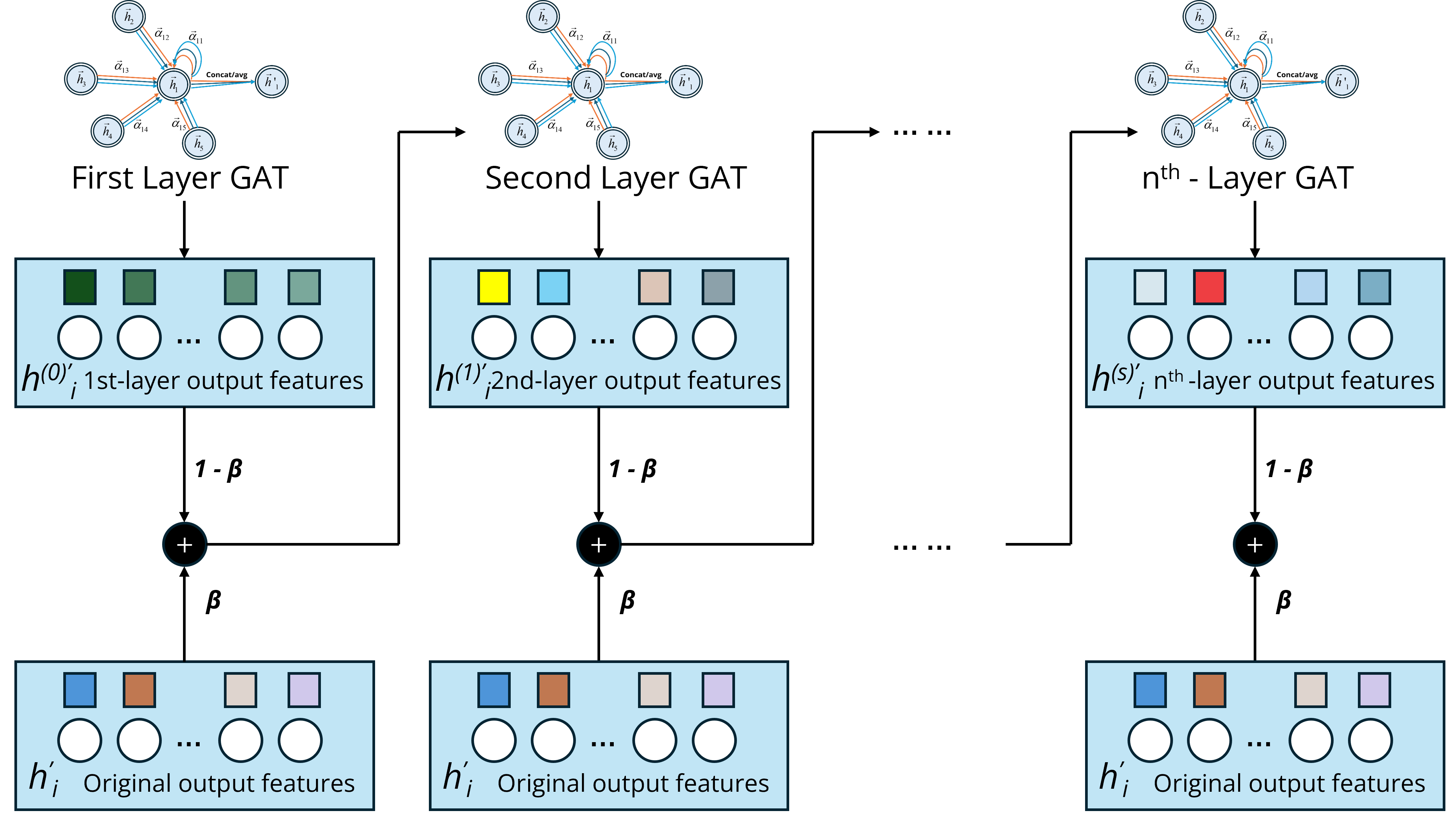
Accurate traffic flow prediction plays a critical role in intelligent transportation systems, providing essential support for urban planning, traffic control, and congestion mitigation. To address the challenges of spatial heterogeneity and temporal dynamics inherent in traffic data, this paper proposes AST-GNNFormer, an adaptive spatio-temporal graph neural network that integrates graph attention mechanisms with temporal convolution. The model introduces three key components to enhance predictive accuracy and generalization: (1) a Layer-aware Information Preservation mechanism that mitigates over-smoothing in deep GNNs by retaining original node features across layers; (2) an Inter-Layer Attention Module that dynamically selects and weights informative layer-wise features to improve multi-layer fusion quality; and (3) an Adaptive Graph Learning Module that fuses prior adjacency knowledge with learnable structures, enabling dynamic topology adaptation. Additionally, a Temporal Convolution Module is incorporated to model multi-scale temporal dependencies efficiently. Extensive experiments on real-world benchmark datasets (PEMS04 and PEMS08) demonstrate that AST-GNNFormer significantly outperforms existing state-of-the-art methods in both short-term and long-term traffic forecasting tasks. Ablation studies further confirm the effectiveness of each proposed component.
Graphical Abstract
Keywords
Data Availability Statement
Funding
Conflicts of Interest
Ethical Approval and Consent to Participate
References
- Lv, Y., Duan, Y., Kang, W., Li, Z., & Wang, F. Y. (2014). Traffic flow prediction with big data: A deep learning approach. IEEE transactions on intelligent transportation systems, 16(2), 865-873.
[CrossRef] [Google Scholar] - Tedjopurnomo, D. A., Bao, Z., Zheng, B., Choudhury, F. M., & Qin, A. K. (2020). A survey on modern deep neural network for traffic prediction: Trends, methods and challenges. IEEE Transactions on Knowledge and Data Engineering, 34(4), 1544-1561.
[CrossRef] [Google Scholar] - Hochreiter, S., & Schmidhuber, J. (1997). Long short-term memory. Neural computation, 9(8), 1735-1780.
[CrossRef] [Google Scholar] - Ma, X., Tao, Z., Wang, Y., Yu, H., & Wang, Y. (2015). Long short-term memory neural network for traffic speed prediction using remote microwave sensor data. Transportation Research Part C: Emerging Technologies, 54, 187-197.
[CrossRef] [Google Scholar] - Ke, J., Zheng, H., Yang, H., & Chen, X. M. (2017). Short-term forecasting of passenger demand under on-demand ride services: A spatio-temporal deep learning approach. Transportation research part C: Emerging technologies, 85, 591-608.
[CrossRef] [Google Scholar] - Li, Y., Yu, R., Shahabi, C., & Liu, Y. (2017). Diffusion convolutional recurrent neural network: Data-driven traffic forecasting. arXiv preprint arXiv:1707.01926.
[Google Scholar] - Yu, B., Yin, H., & Zhu, Z. (2017). Spatio-temporal graph convolutional networks: A deep learning framework for traffic forecasting. arXiv preprint arXiv:1709.04875.
[Google Scholar] - Yan, S., Xiong, Y., & Lin, D. (2018, April). Spatial temporal graph convolutional networks for skeleton-based action recognition. In Proceedings of the AAAI conference on artificial intelligence (Vol. 32, No. 1).
[CrossRef] [Google Scholar] - Guo, S., Lin, Y., Feng, N., Song, C., & Wan, H. (2019, July). Attention based spatial-temporal graph convolutional networks for traffic flow forecasting. In Proceedings of the AAAI conference on artificial intelligence (Vol. 33, No. 01, pp. 922-929).
[CrossRef] [Google Scholar] - Zheng, C., Fan, X., Wang, C., & Qi, J. (2020, April). Gman: A graph multi-attention network for traffic prediction. In Proceedings of the AAAI conference on artificial intelligence (Vol. 34, No. 01, pp. 1234-1241).
[CrossRef] [Google Scholar] - Wu, Z., Pan, S., Long, G., Jiang, J., & Zhang, C. (2019). Graph wavenet for deep spatial-temporal graph modeling. arXiv preprint arXiv:1906.00121.
[Google Scholar] - Wu, Z., Pan, S., Long, G., Jiang, J., Chang, X., & Zhang, C. (2020, August). Connecting the dots: Multivariate time series forecasting with graph neural networks. In Proceedings of the 26th ACM SIGKDD international conference on knowledge discovery & data mining (pp. 753-763).
[CrossRef] [Google Scholar] - Bai, L., Yao, L., Li, C., Wang, X., & Wang, C. (2020). Adaptive graph convolutional recurrent network for traffic forecasting. Advances in neural information processing systems, 33, 17804-17815.
[Google Scholar] - Zheng, Y., Yi, L., & Wei, Z. (2025). A survey of dynamic graph neural networks. Frontiers of Computer Science, 19(6), 196323.
[CrossRef] [Google Scholar] - Dai, B. A., Ye, B. L., & Li, L. (2024). A novel hybrid time-varying graph neural network for traffic flow forecasting. arXiv preprint arXiv:2401.10155.
[Google Scholar] - Lu, S., Chen, H., & Teng, Y. (2024). Multi-scale non-local spatio-temporal information fusion networks for multi-step traffic flow forecasting. ISPRS International Journal of Geo-Information, 13(3), 71.
[CrossRef] [Google Scholar] - Xiong, L., Yuan, X., Hu, Z., Huang, X., & Huang, P. (2024). Gated fusion adaptive graph neural network for urban road traffic flow prediction. Neural Processing Letters, 56(1), 9.
[CrossRef] [Google Scholar] - Yaqub, M., Ahmad, S., Manan, M. A., Pathan, M. S., & He, L. (2025). Predicting traffic flow with federated learning and graph neural with asynchronous computations network. Array, 100411.
[CrossRef] [Google Scholar] - Jiang, W., & Luo, J. (2022). Graph neural network for traffic forecasting: A survey. Expert systems with applications, 207, 117921.
[CrossRef] [Google Scholar] - Bai, S., Kolter, J. Z., & Koltun, V. (2018). An empirical evaluation of generic convolutional and recurrent networks for sequence modeling. arXiv preprint arXiv:1803.01271.
[Google Scholar] - Smith, B. L., Williams, B. M., & Oswald, R. K. (2002). Comparison of parametric and nonparametric models for traffic flow forecasting. Transportation Research Part C: Emerging Technologies, 10(4), 303-321.
[CrossRef] [Google Scholar] - Williams, B. M., & Hoel, L. A. (2003). Modeling and forecasting vehicular traffic flow as a seasonal ARIMA process: Theoretical basis and empirical results. Journal of transportation engineering, 129(6), 664-672.
[CrossRef] [Google Scholar] - Kipf, T. N. (2016). Semi-supervised classification with graph convolutional networks. arXiv preprint arXiv:1609.02907.
[Google Scholar] - Li, M., & Zhu, Z. (2021, May). Spatial-temporal fusion graph neural networks for traffic flow forecasting. In Proceedings of the AAAI conference on artificial intelligence (Vol. 35, No. 5, pp. 4189-4196).
[CrossRef] [Google Scholar]
Cited By (2)
-
Mohammed Saad Javeed, Md Al Rafi, Md Shariful Alam Bhuiyan, M. F. Mridha, Md. Jakir Hossen. Deep Learning–Reinforced Self-Adaptive CI/CD Framework for Traffic-Aware Deployment in Intelligent Transportation Systems.
IEEE Open Journal of Intelligent Transportation Systems, 2026 , 7 .
[CrossRef] -
Hongjuan Wang, Chenxi Wang, Xinjun An. DKTransformer: An Accurate and Efficient Model for Fine-Grained Food Image Classification.
Sensors, 2026 , 26 (4).
[CrossRef]
Cite This Article
TY  - JOUR
AU  - Zheng, Yusen
AU  - Jin, Xuebo
PY  - 2025
DA  - 2025/10/26
TI  - AST-GNNFormer: Adaptive Spatio-Temporal Graph Neural Network with Layer-Aware Preservation for Traffic Flow Prediction
JO  - ICCK Transactions on Emerging Topics in Artificial Intelligence
T2  - ICCK Transactions on Emerging Topics in Artificial Intelligence
JF  - ICCK Transactions on Emerging Topics in Artificial Intelligence
VL  - 2
IS  - 4
SP  - 203
EP  - 219
DO  - 10.62762/TETAI.2025.387543
UR  - https://www.icck.org/article/abs/TETAI.2025.387543
KW  - graph neural network
KW  - traffic flow prediction
KW  - adaptive graph learning
KW  - inter-layer attention mechanism
AB  - Accurate traffic flow prediction plays a critical role in intelligent transportation systems, providing essential support for urban planning, traffic control, and congestion mitigation. To address the challenges of spatial heterogeneity and temporal dynamics inherent in traffic data, this paper proposes AST-GNNFormer, an adaptive spatio-temporal graph neural network that integrates graph attention mechanisms with temporal convolution. The model introduces three key components to enhance predictive accuracy and generalization: (1) a Layer-aware Information Preservation mechanism that mitigates over-smoothing in deep GNNs by retaining original node features across layers; (2) an Inter-Layer Attention Module that dynamically selects and weights informative layer-wise features to improve multi-layer fusion quality; and (3) an Adaptive Graph Learning Module that fuses prior adjacency knowledge with learnable structures, enabling dynamic topology adaptation. Additionally, a Temporal Convolution Module is incorporated to model multi-scale temporal dependencies efficiently. Extensive experiments on real-world benchmark datasets (PEMS04 and PEMS08) demonstrate that AST-GNNFormer significantly outperforms existing state-of-the-art methods in both short-term and long-term traffic forecasting tasks. Ablation studies further confirm the effectiveness of each proposed component.
SN  - 3068-6652
PB  - Institute of Central Computation and Knowledge
LA  - English
ER  -
@article{Zheng2025ASTGNNForm,
  author = {Yusen Zheng and Xuebo Jin},
  title = {AST-GNNFormer: Adaptive Spatio-Temporal Graph Neural Network with Layer-Aware Preservation for Traffic Flow Prediction},
  journal = {ICCK Transactions on Emerging Topics in Artificial Intelligence},
  year = {2025},
  volume = {2},
  number = {4},
  pages = {203-219},
  doi = {10.62762/TETAI.2025.387543},
  url = {https://www.icck.org/article/abs/TETAI.2025.387543},
  abstract = {Accurate traffic flow prediction plays a critical role in intelligent transportation systems, providing essential support for urban planning, traffic control, and congestion mitigation. To address the challenges of spatial heterogeneity and temporal dynamics inherent in traffic data, this paper proposes AST-GNNFormer, an adaptive spatio-temporal graph neural network that integrates graph attention mechanisms with temporal convolution. The model introduces three key components to enhance predictive accuracy and generalization: (1) a Layer-aware Information Preservation mechanism that mitigates over-smoothing in deep GNNs by retaining original node features across layers; (2) an Inter-Layer Attention Module that dynamically selects and weights informative layer-wise features to improve multi-layer fusion quality; and (3) an Adaptive Graph Learning Module that fuses prior adjacency knowledge with learnable structures, enabling dynamic topology adaptation. Additionally, a Temporal Convolution Module is incorporated to model multi-scale temporal dependencies efficiently. Extensive experiments on real-world benchmark datasets (PEMS04 and PEMS08) demonstrate that AST-GNNFormer significantly outperforms existing state-of-the-art methods in both short-term and long-term traffic forecasting tasks. Ablation studies further confirm the effectiveness of each proposed component.},
  keywords = {graph neural network, traffic flow prediction, adaptive graph learning, inter-layer attention mechanism},
  issn = {3068-6652},
  publisher = {Institute of Central Computation and Knowledge}
}
Publisher's Note
ICCK stays neutral with regard to jurisdictional claims in published maps and institutional affiliations.
Rights and Permissions
 Copyright © 2025 by the Author(s). Published by Institute of Central Computation and Knowledge. This article is an open access article distributed under the terms and conditions of the Creative Commons Attribution (CC BY) license (https://creativecommons.org/licenses/by/4.0/), which permits use, sharing, adaptation, distribution and reproduction in any medium or format, as long as you give appropriate credit to the original author(s) and the source, provide a link to the Creative Commons licence, and indicate if changes were made.


Portico
