

Visual Intelligence for Automated Fall Sensing: A Systematic Review of Architectures, Datasets, and Evaluation Gaps





Article Information
Abstract
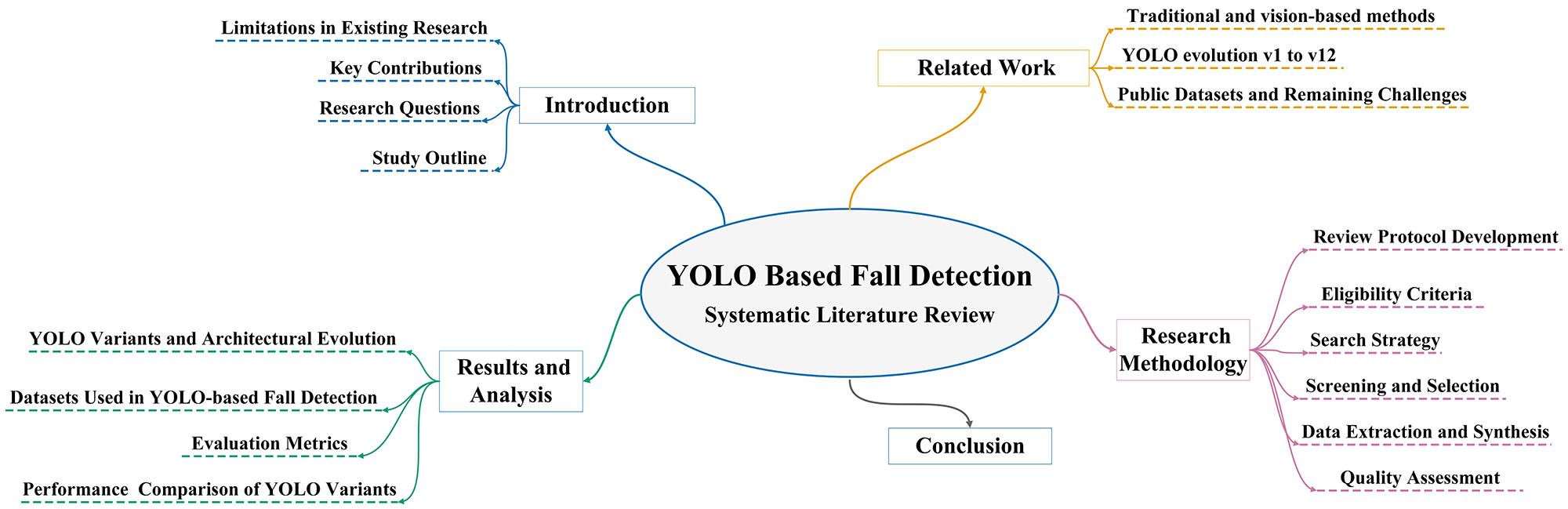
Falls are a major cause of injury, hospitalization, and loss of independence among older adults, spurring interest in visual intelligence-based automated fall detection for timely response and continuous monitoring. This article presents a systematic review of such systems, focusing on YOLO-based approaches. Following PRISMA guidelines, the review covers 2016–2025 literature, identifying 637 records and including 63 studies after screening. We examine datasets, preprocessing strategies, evaluation protocols, metrics, and hardware platforms, comparing reported accuracy, efficiency, and real-time feasibility across different designs. Evidence is strongest for YOLOv3 through YOLOv9, while evidence for YOLOv1–YOLOv2 and YOLOv10–YOLOv12 remains limited or preliminary. Reviewed studies show steady performance gains on public datasets, but key limitations persist: most evaluations use staged or lab-controlled data, cross-dataset and cross-site testing are uncommon, and deployment factors like end-to-end latency, edge device performance, and long-term stability are under-reported. This review consolidates current practices and identifies priorities for more standardized, deployment-relevant reporting.
Graphical Abstract
Keywords
Data Availability Statement
Funding
Conflicts of Interest
AI Use Statement
Ethical Approval and Consent to Participate
References
- World Health Organization. (2021). Falls. WHO Newsroom Fact sheets. Retrieved from https://www.who.int/news-room/fact-sheets/detail/falls
[Google Scholar] - Noury, N., Fleury, A., Rumeau, P., Bourke, A. K., Laighin, G. O., Rialle, V., & Lundy, J. E. (2007, August). Fall detection-principles and methods. In 2007 29th annual international conference of the IEEE engineering in medicine and biology society (pp. 1663-1666). IEEE.
[CrossRef] [Google Scholar] - Vaiyapuri, T., Lydia, E. L., Sikkandar, M. Y., Díaz, V. G., Pustokhina, I. V., & Pustokhin, D. A. (2021). Internet of things and deep learning enabled elderly fall detection model for smart homecare. IEEE Access, 9, 113879-113888.
[CrossRef] [Google Scholar] - Bourke, A. K., & Lyons, G. M. (2008). A threshold-based fall-detection algorithm using a bi-axial gyroscope sensor. Medical engineering & physics, 30(1), 84-90.
[CrossRef] [Google Scholar] - Kepski, M., & Kwolek, B. (2014, August). Detecting human falls with 3-axis accelerometer and depth sensor. In 2014 36th Annual International Conference of the IEEE Engineering in Medicine and Biology Society (pp. 770-773). IEEE.
[CrossRef] [Google Scholar] - Gutiérrez, J., Rodríguez, V., & Martin, S. (2021). Comprehensive review of vision-based fall detection systems. Sensors, 21(3), 947.
[CrossRef] [Google Scholar] - Alam, E., Sufian, A., Dutta, P., & Leo, M. (2022). Vision-based human fall detection systems using deep learning: A review. Computers in biology and medicine, 146, 105626.
[CrossRef] [Google Scholar] - Espinosa, R., Ponce, H., Gutiérrez, S., Martínez-Villaseñor, L., Brieva, J., & Moya-Albor, E. (2019). A vision-based approach for fall detection using multiple cameras and convolutional neural networks: A case study using the UP-Fall detection dataset. Computers in biology and medicine, 115, 103520.
[CrossRef] [Google Scholar] - Priadana, A., Nguyen, D. L., Vo, X. T., Choi, J., Ashraf, R., & Jo, K. (2025). HFD-YOLO: Improved YOLO Network Using Efficient Attention Modules for Real-Time One-Stage Human Fall Detection. IEEE Access, 13, 41248-41258.
[CrossRef] [Google Scholar] - Zi, X., Chaturvedi, K., Braytee, A., Li, J., & Prasad, M. (2023). Detecting human falls in poor lighting: object detection and tracking approach for indoor safety. Electronics, 12(5), 1259.
[CrossRef] [Google Scholar] - Zeng, G., Zeng, B., & Hu, H. (2023). Real-world efficient fall detection: Balancing performance and complexity with FDGA workflow. Computer Vision and Image Understanding, 237, 103832.
[CrossRef] [Google Scholar] - Khalili, S., Mohammadzade, H., & Ahmadi, M. M. (2022). Elderly fall detection using CCTV cameras under partial occlusion of the subjects body. arXiv preprint arXiv:2208.07291.
[CrossRef] [Google Scholar] - Schneider, D., Marinov, Z., Baur, R., Zhong, Z., Düger, R., & Stiefelhagen, R. (2025). OmniFall: A Unified Staged-to-Wild Benchmark for Human Fall Detection. arXiv preprint arXiv:2505.19889.
[CrossRef] [Google Scholar] - Denkovski, S., Khan, S. S., Malamis, B., Moon, S. Y., Ye, B., & Mihailidis, A. (2022). Multi visual modality fall detection dataset. IEEE Access, 10, 106422-106435.
[CrossRef] [Google Scholar] - Huang, X., Li, X., Yuan, L., Jiang, Z., Jin, H., Wu, W., ... & Bai, H. (2025). SDES-YOLO: A high-precision and lightweight model for fall detection in complex environments. Scientific Reports, 15(1), 2026.
[CrossRef] [Google Scholar] - He, K., Zhang, X., Ren, S., & Sun, J. (2016). Deep residual learning for image recognition. In Proceedings of the IEEE conference on computer vision and pattern recognition (pp. 770-778).
[CrossRef] [Google Scholar] - Lin, T. Y., Dollár, P., Girshick, R., He, K., Hariharan, B., & Belongie, S. (2017). Feature pyramid networks for object detection. In Proceedings of the IEEE conference on computer vision and pattern recognition (pp. 2117-2125).
[CrossRef] [Google Scholar] - Liu, S., Qi, L., Qin, H., Shi, J., & Jia, J. (2018). Path aggregation network for instance segmentation. In Proceedings of the IEEE conference on computer vision and pattern recognition (pp. 8759-8768).
[CrossRef] [Google Scholar] - Cubuk, E. D., Zoph, B., Mane, D., Vasudevan, V., & Le, Q. V. (2019). Autoaugment: Learning augmentation strategies from data. In Proceedings of the IEEE/CVF conference on computer vision and pattern recognition (pp. 113-123).
[CrossRef] [Google Scholar] - Tan, M., Pang, R., & Le, Q. V. (2020, June). EfficientDet: Scalable and Efficient Object Detection. In 2020 IEEE/CVF Conference on Computer Vision and Pattern Recognition (CVPR) (pp. 10778-10787). IEEE.
[CrossRef] [Google Scholar] - Zhang, S., Chi, C., Yao, Y., Lei, Z., & Li, S. Z. (2020, June). Bridging the Gap Between Anchor-Based and Anchor-Free Detection via Adaptive Training Sample Selection. In 2020 IEEE/CVF Conference on Computer Vision and Pattern Recognition (CVPR) (pp. 9756-9765). IEEE.
[CrossRef] [Google Scholar] - Khekan, A. R., Aghdasi, H. S., & Salehpour, P. (2024). The impact of YOLO Algorithms within fall detection application: A review. IEEE Access, 13, 6793-6809.
[CrossRef] [Google Scholar] - Kangas, M., Konttila, A., Lindgren, P., Winblad, I., & Jämsä, T. (2008). Comparison of low-complexity fall detection algorithms for body attached accelerometers. Gait & posture, 28(2), 285-291.
[CrossRef] [Google Scholar] - Redmon, J., Divvala, S., Girshick, R., & Farhadi, A. (2016). You only look once: Unified, real-time object detection. In Proceedings of the IEEE conference on computer vision and pattern recognition (pp. 779-788).
[CrossRef] [Google Scholar] - J. Redmon and A. Farhadi (2018). Yolov3: An incremental improvement. arXiv preprint arXiv:1804.02767.
[CrossRef] [Google Scholar] - Redmon, J., & Farhadi, A. (2017, July). YOLO9000: Better, Faster, Stronger. In 2017 IEEE Conference on Computer Vision and Pattern Recognition (CVPR) (pp. 6517-6525). IEEE.
[CrossRef] [Google Scholar] - Raza, A., Yousaf, M. H., & Velastin, S. A. (2022, June). Human fall detection using YOLO: a real-time and AI-on-the-edge perspective. In 2022 12th International Conference on Pattern Recognition Systems (ICPRS) (pp. 1-6). IEEE.
[CrossRef] [Google Scholar] - Zhang, J., Wu, C., & Wang, Y. (2020). Human fall detection based on body posture spatio-temporal evolution. Sensors, 20(3), 946.
[CrossRef] [Google Scholar] - Hussain, M. (2024). Yolov5, yolov8 and yolov10: The go-to detectors for real-time vision. arXiv preprint arXiv:2407.02988.
[CrossRef] [Google Scholar] - Bochkovskiy, A., Wang, C. Y., & Liao, H. Y. M. (2020). Yolov4: Optimal speed and accuracy of object detection. arXiv preprint arXiv:2004.10934.
[CrossRef] [Google Scholar] - Liu, Z., Mao, H., Wu, C. Y., Feichtenhofer, C., Darrell, T., & Xie, S. (2022). A convnet for the 2020s. In Proceedings of the IEEE/CVF conference on computer vision and pattern recognition (pp. 11976-11986).
[CrossRef] [Google Scholar] - Gaya-Morey, F. X., Manresa-Yee, C., & Buades-Rubio, J. M. (2024). Deep learning for computer vision based activity recognition and fall detection of the elderly: a systematic review. Applied Intelligence, 54(19), 8982-9007.
[CrossRef] [Google Scholar] - Jocher, G., Stoken, A., Chaurasia, A., Borovec, J., Kwon, Y., Michael, K., ... & Thanh Minh, M. (2021). ultralytics/yolov5: v6. 0-YOLOv5n'Nano'models, Roboflow integration, TensorFlow export, OpenCV DNN support. Zenodo.
[CrossRef] [Google Scholar] - Chen, T., Ding, Z., & Li, B. (2022). Elderly fall detection based on improved YOLOv5s network. IEEE Access, 10, 91273-91282.
[CrossRef] [Google Scholar] - Li, X., Wang, W., Hu, X., Li, J., Tang, J., & Yang, J. (2021, June). Generalized Focal Loss V2: Learning Reliable Localization Quality Estimation for Dense Object Detection. In 2021 IEEE/CVF Conference on Computer Vision and Pattern Recognition (CVPR) (pp. 11627-11636). IEEE.
[CrossRef] [Google Scholar] - Li, C., Li, L., Jiang, H., Weng, K., Geng, Y., Li, L., ... & Wei, X. (2022). YOLOv6: A single-stage object detection framework for industrial applications. arXiv preprint arXiv:2209.02976.
[CrossRef] [Google Scholar] - Ding, X., Zhang, X., Ma, N., Han, J., Ding, G., & Sun, J. (2021, June). RepVGG: Making VGG-style ConvNets Great Again. In 2021 IEEE/CVF Conference on Computer Vision and Pattern Recognition (CVPR) (pp. 13728-13737). IEEE.
[CrossRef] [Google Scholar] - Wang, C. Y., Bochkovskiy, A., & Liao, H. Y. M. (2023, June). YOLOv7: Trainable Bag-of-Freebies Sets New State-of-the-Art for Real-Time Object Detectors. In 2023 IEEE/CVF Conference on Computer Vision and Pattern Recognition (CVPR) (pp. 7464-7475). IEEE.
[CrossRef] [Google Scholar] - Zhao, D., Song, T., Gao, J., Li, D., & Niu, Y. (2024). Yolo-fall: A novel convolutional neural network model for fall detection in open spaces. IEEE Access, 12, 26137-26149.
[CrossRef] [Google Scholar] - Sohan, M., Sai Ram, T., & Rami Reddy, C. V. (2024). A review on yolov8 and its advancements. In International conference on data intelligence and cognitive informatics (pp. 529-545). Springer, Singapore.
[CrossRef] [Google Scholar] - Sanjalawe, Y., Fraihat, S., Abualhaj, M., Al-E’Mari, S. R., & Alzubi, E. (2025). Hybrid deep learning for human fall detection: A synergistic approach using YOLOv8 and time-space transformers. IEEE Access, 13, 41336-41366.
[CrossRef] [Google Scholar] - Dao, T., Fu, D., Ermon, S., Rudra, A., & Ré, C. (2022). Flashattention: Fast and memory-efficient exact attention with io-awareness. Advances in neural information processing systems, 35, 16344-16359.
[CrossRef] [Google Scholar] - Wang, S., Li, B. Z., Khabsa, M., Fang, H., & Ma, H. (2020). Linformer: Self-attention with linear complexity. arXiv preprint arXiv:2006.04768.
[CrossRef] [Google Scholar] - Choromanski, K., Likhosherstov, V., Dohan, D., Song, X., Gane, A., Sarlos, T., ... & Weller, A. (2020). Rethinking attention with performers. arXiv preprint arXiv:2009.14794.
[CrossRef] [Google Scholar] - Bolya, D., Fu, C. Y., Dai, X., Zhang, P., Feichtenhofer, C., & Hoffman, J. (2022). Token merging: Your vit but faster. arXiv preprint arXiv:2210.09461.
[CrossRef] [Google Scholar] - Tîrziu, E., Vasilevschi, A. M., Alexandru, A., & Tudora, E. (2025). Real-time fall monitoring for seniors via YOLO and voice interaction. Future Internet, 17(8), 324.
[CrossRef] [Google Scholar] - Kong, V., Soeng, S., Thon, M., Cho, W. S., Nayyar, A., & Kim, T. K. (2025). PIFR: A novel approach for analyzing pose angle-based human activity to automate fall detection in videos. Plos one, 20(6), e0325253.
[CrossRef] [Google Scholar] - Wang, A., Chen, H., Liu, L., Chen, K., Lin, Z., Han, J., & Ding, G. (2024). Yolov10: Real-time end-to-end object detection. Advances in neural information processing systems, 37, 107984-108011.
[CrossRef] [Google Scholar] - Zhao, Y., Lv, W., Xu, S., Wei, J., Wang, G., Dang, Q., ... & Chen, J. (2024, June). DETRs Beat YOLOs on Real-time Object Detection. In 2024 IEEE/CVF Conference on Computer Vision and Pattern Recognition (CVPR) (pp. 16965-16974). IEEE.
[CrossRef] [Google Scholar] - Khan, H., Ullah, I., Shabaz, M., Omer, M. F., Usman, M. T., Guellil, M. S., & Koo, J. (2024). Visionary vigilance: Optimized YOLOV8 for fallen person detection with large-scale benchmark dataset. Image and Vision Computing, 149, 105195.
[CrossRef] [Google Scholar] - Syamsul, M., & Wibowo, S. A. (2024, December). Optimizers Comparative Analysis on YOLOv8 and YOLOv11 for Small Object Detection. In 2024 International Conference on Intelligent Cybernetics Technology & Applications (ICICyTA) (pp. 978-983). IEEE.
[CrossRef] [Google Scholar] - Menaka, S. R., Kamali, R., Hariesh, R., & Vengatesh, K. (2025, August). Enhancing Accuracy in Real-Time Object Detection Using YOLOv12 Model with Transformer-Based Attention Mechanisms. In 2025 International Conference on Next Generation Computing Systems (ICNGCS) (pp. 1-8). IEEE.
[CrossRef] [Google Scholar] - Page, M. J., McKenzie, J. E., Bossuyt, P. M., Boutron, I., Hoffmann, T. C., Mulrow, C. D., ... & Moher, D. (2021). The PRISMA 2020 statement: an updated guideline for reporting systematic reviews. bmj, 372.
[CrossRef] [Google Scholar] - Kepski, M., & Kwolek, B. (2018). Event‐driven system for fall detection using body‐worn accelerometer and depth sensor. IET Computer Vision, 12(1), 48-58.
[CrossRef] [Google Scholar] - Vishnu, C., Datla, R., Roy, D., Babu, S., & Mohan, C. K. (2021). Human fall detection in surveillance videos using fall motion vector modeling. IEEE Sensors Journal, 21(15), 17162-17170.
[CrossRef] [Google Scholar] - Shahroudy, A., Liu, J., Ng, T. T., & Wang, G. (2016, June). NTU RGB+ D: A Large Scale Dataset for 3D Human Activity Analysis. In 2016 IEEE Conference on Computer Vision and Pattern Recognition (CVPR) (pp. 1010-1019). IEEE.
[CrossRef] [Google Scholar] - Guerrero, J. C. E., España, E. M., Añasco, M. M., & Lopera, J. E. P. (2022). Dataset for human fall recognition in an uncontrolled environment. Data in brief, 45, 108610.
[CrossRef] [Google Scholar] - Zaghden, N., Ibrahim, E., Safaldin, M., & Mejdoub, M. (2025). Integrating Attention Mechanisms in YOLOv8 for Improved Fall Detection Performance. Computers, Materials & Continua, 83(1). http://dx.doi.org/10.32604/cmc.2025.061948
[Google Scholar] - Powers, D. M. (2020). Evaluation: from precision, recall and F-measure to ROC, informedness, markedness and correlation. arXiv preprint arXiv:2010.16061.
[CrossRef] [Google Scholar] - Rezatofighi, H., Tsoi, N., Gwak, J., Sadeghian, A., Reid, I., & Savarese, S. (2019, June). Generalized Intersection Over Union: A Metric and a Loss for Bounding Box Regression. In 2019 IEEE/CVF Conference on Computer Vision and Pattern Recognition (CVPR) (pp. 658-666). IEEE.
[CrossRef] [Google Scholar] - Kwolek, B., & Kepski, M. (2014). Human fall detection on embedded platform using depth maps and wireless accelerometer. Computer methods and programs in biomedicine, 117(3), 489-501.
[CrossRef] [Google Scholar] - Luo, Z., Jia, S., Niu, H., Zhao, Y., Zeng, X., & Dong, G. (2024). Elderly fall detection algorithm based on improved YOLOv5s. Information Technology and Control, 53(2), 601-618.
[CrossRef] [Google Scholar] - M.A.R. Alif and M. Hussain (2024). YOLOv1 to YOLOv10: A comprehensive review of YOLO variants and their application in the agricultural domain. arXiv preprint arXiv:2406.10139.
[CrossRef] [Google Scholar]
Cite This Article
TY  - JOUR
AU  - Zeb, Babar
AU  - Usman, Muhammad Talha
AU  - Khan, Habib
AU  - Gazis, Alexandros
AU  - Pappas, Stylianos
AU  - Omer, Muhammad Faizan
AU  - Rahim, Nasir
PY  - 2026
DA  - 2026/06/27
TI  - Visual Intelligence for Automated Fall Sensing: A Systematic Review of Architectures, Datasets, and Evaluation Gaps
JO  - ICCK Transactions on Sensing, Communication, and Control
T2  - ICCK Transactions on Sensing, Communication, and Control
JF  - ICCK Transactions on Sensing, Communication, and Control
VL  - 3
IS  - 2
SP  - 90
EP  - 108
DO  - 10.62762/TSCC.2026.604481
UR  - https://www.icck.org/article/abs/TSCC.2026.604481
KW  - fall detection
KW  - visual monitoring
KW  - object detection
KW  - systematic review
KW  - edge devices
KW  - real-time
KW  - assisted living
AB  - Falls are a major cause of injury, hospitalization, and loss of independence among older adults, spurring interest in visual intelligence-based automated fall detection for timely response and continuous monitoring. This article presents a systematic review of such systems, focusing on YOLO-based approaches. Following PRISMA guidelines, the review covers 2016–2025 literature, identifying 637 records and including 63 studies after screening. We examine datasets, preprocessing strategies, evaluation protocols, metrics, and hardware platforms, comparing reported accuracy, efficiency, and real-time feasibility across different designs. Evidence is strongest for YOLOv3 through YOLOv9, while evidence for YOLOv1–YOLOv2 and YOLOv10–YOLOv12 remains limited or preliminary. Reviewed studies show steady performance gains on public datasets, but key limitations persist: most evaluations use staged or lab-controlled data, cross-dataset and cross-site testing are uncommon, and deployment factors like end-to-end latency, edge device performance, and long-term stability are under-reported. This review consolidates current practices and identifies priorities for more standardized, deployment-relevant reporting.
SN  - 3068-9287
PB  - Institute of Central Computation and Knowledge
LA  - English
ER  -
@article{Zeb2026Visual,
  author = {Babar Zeb and Muhammad Talha Usman and Habib Khan and Alexandros Gazis and Stylianos Pappas and Muhammad Faizan Omer and Nasir Rahim},
  title = {Visual Intelligence for Automated Fall Sensing: A Systematic Review of Architectures, Datasets, and Evaluation Gaps},
  journal = {ICCK Transactions on Sensing, Communication, and Control},
  year = {2026},
  volume = {3},
  number = {2},
  pages = {90-108},
  doi = {10.62762/TSCC.2026.604481},
  url = {https://www.icck.org/article/abs/TSCC.2026.604481},
  abstract = {Falls are a major cause of injury, hospitalization, and loss of independence among older adults, spurring interest in visual intelligence-based automated fall detection for timely response and continuous monitoring. This article presents a systematic review of such systems, focusing on YOLO-based approaches. Following PRISMA guidelines, the review covers 2016–2025 literature, identifying 637 records and including 63 studies after screening. We examine datasets, preprocessing strategies, evaluation protocols, metrics, and hardware platforms, comparing reported accuracy, efficiency, and real-time feasibility across different designs. Evidence is strongest for YOLOv3 through YOLOv9, while evidence for YOLOv1–YOLOv2 and YOLOv10–YOLOv12 remains limited or preliminary. Reviewed studies show steady performance gains on public datasets, but key limitations persist: most evaluations use staged or lab-controlled data, cross-dataset and cross-site testing are uncommon, and deployment factors like end-to-end latency, edge device performance, and long-term stability are under-reported. This review consolidates current practices and identifies priorities for more standardized, deployment-relevant reporting.},
  keywords = {fall detection, visual monitoring, object detection, systematic review, edge devices, real-time, assisted living},
  issn = {3068-9287},
  publisher = {Institute of Central Computation and Knowledge}
}
Article Metrics
Publisher's Note
ICCK stays neutral with regard to jurisdictional claims in published maps and institutional affiliations.
Rights and Permissions


Portico
